Nothing will benefit human health and increase the chances for survival of life on Earth as much as the evolution to a vegetarian diet. - Albert Einstein
Carl Jung is one of the greatest western psychologists to have ever existed. Through unlocking the mysteries of our unconscious, he helped people discover their true selves.
He spoke about the beauty of becoming “spiritually whole” and the value in asking ourselves the hard questions. Here is an example from one his quotes: “I have frequently seen people become neurotic when they content themselves with inadequate or wrong answers to the questions of life. They seek position, marriage, reputation, outward success of money, and remain unhappy and neurotic even when they have attained what they were seeking. Such people are usually confined within too narrow a spiritual horizon. Their life has not sufficient content, sufficient meaning. If they are enabled to develop into more spacious personalities, the neurosis generally disappears.”
So when such a revolutionary western thinker talks about becoming our true selves, it’s fascinating to see what he thinks of Zen philosophy. As we all know, Zen philosophy is mainly focused on reducing suffering through achieving “enlightenment”.
Below is a forward by Carl Jung for “An Introduction to Zen Buddhism” by D.T Suzuki: “I should like to warn the attentive and sympathetic reader, however, not to underestimate the spiritual depth of the East, or to assume that there is anything cheap and facile about Zen.
The assiduously cultivated credulity of the West in regard to Eastern thought is in this case a lesser danger, as in Zen there are fortunately none of those marvelously incomprehensible words that we find in Indian cults.
Neither does Zen play about with complicated hatha-yoga techniques, which delude the physiologically minded European into the false hope that the spirit can be obtained by just sitting and breathing.
On the contrary, Zen demands intelligence and will power, as do all greater things that want to become realities.” – Carl Jung
For more wisdom from Carl Jung, check out these articles:
n both ancient lore and modern culture, we hear much about the
Buddha's road to enlightenment – from his birth to his parinirvana, or
death.
But missing from most accounts of Prince Siddhartha's life are the
women who influenced him along the way and who played a significant role
in his journey of awakening.
Wendy Garling is a writer, dharma teacher, and practicing Tibetan
Buddhist. When she realized many of those stories were "hiding in plain
sight," Garling began digging to find out more about the women in the
Buddha's circle.
A retelling of the ancient legends of the women in the Buddha’s intimate circle by author Wendy Garling
Drawing on rare and lesser-known stories from ancient Sanskrit and
Pali sources, Garling reinterprets the legends of the women in the
Buddha's intimate circle in her book Stars at Dawn: Forgotten Stories of Women in the Buddha's Life.
Her retelling of these ancient stories exposes the bias of those who
first wrote down those stories, challenges the common understanding of
women's roles in early Buddhism and sheds light on the sacred feminine
in the faith.
"It's important to remember that at the time of the Buddha,
everything was communicated through the oral traditions," Garling points
out. "The stories that sprang up around his life were not written down
for many hundreds of years… So there's no one way the stories were
told."
She notes that many of the early stories were initially written down
by monks at Buddhist monasteries, and those men may have focused on the
more religious aspects of the Buddha's life and teachings, discarding
details they deemed irrelevant.
"I think the forgotten stories I found - that are so important and so
different - were less edited, frankly," she adds. "In many cases, they
had no real religious purpose, but they were telling wonderful stories –
stories about the Buddha, and stories about women."
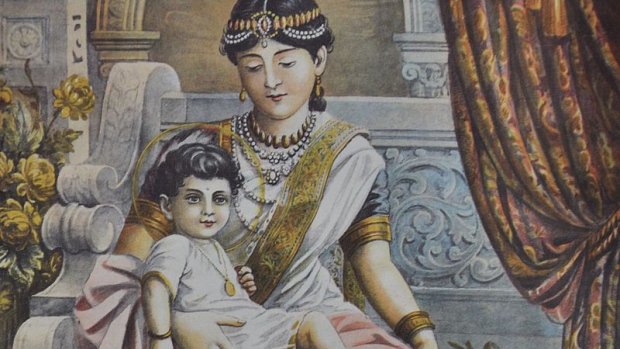
Maya's dream of the birth of Gautama Siddharta, the Buddha
Here are some highlights:
Garling says traditional tellings of the Buddha's birth story seldom include women, even omitting the Buddha's birth mother, Mayadevi.
Those accounts that do include Maya depict her as giving birth standing
up, holding onto a tree for support, as Siddhartha emerged from her
right side, with no blood or water exuded during the labour.
Maya is thought to have died shortly afterwards, leaving Siddhartha to be raised by her sister, Mahapajapati,
who is said to have been present at the birth. Artistic renderings
often depict Mahapajapati holding Maya around the waist during the
labour – symbolizing the role of both mothers in the Buddha's life.
Later, after her husband died, Mahapajapati became a nun. When the
Buddha finally decided to leave his palace home as he moved towards
enlightenment, it was his second mother's tears and wisdom that sent him
on his way.
Painting of the birth of Gautama Buddha, out of the side of Queen Mahamaya
Goddesses played a role in early Buddhism. For instance,
Garling argues the tree Maya held onto during the Buddha's birth was
actually Abhayadevi, a goddess of protection who lowered her branch to
support Maya during birth. Buddhism includes many female deities,
including goddesses of peace, compassion, and liberation.
Before he became the Buddha, Siddhartha had a harem of women.
In a commonly told story, the consorts are ordered by Brahmin gods to
appear vulgar and ugly in order to repel Siddhartha from desire and
other earthly gratification. In Garling's retelling, at the urging of a
wisdom goddess, the women themselves conspire to drive Siddhartha away.
Instead of being passive, the women actively help release Siddhartha
from his final attachment.
Philosopher Erich Fromm on the Art of Loving and What Is Keeping Us from Mastering It
“There is hardly any activity, any enterprise, which is started
with such tremendous hopes and expectations, and yet, which fails so
regularly, as love.”
By Maria Popova
“To love without knowing how to love wounds the person we love,” the great Zen teacher Thich Nhat Hahn admonished in his terrific treatise on how to love
— a sentiment profoundly discomfiting in the context of our cultural
mythology, which continually casts love as something that happens to us
passively and by chance, something we fall into, something that strikes
us arrow-like, rather than a skill attained through the same deliberate practice as any other pursuit of human excellence. Our failure to recognize this skillfulness aspect is perhaps the primary reason why love is so intertwined with frustration.
That’s what the great German social psychologist, psychoanalyst, and philosopher Erich Fromm (March 23, 1900–March 18, 1980) examines in his 1956 masterwork The Art of Loving (public library)
— a case for love as a skill to be honed the way artists apprentice
themselves to the work on the way to mastery, demanding of its
practitioner both knowledge and effort.
Erich Fromm
Fromm writes:
This book … wants to show that love is not a sentiment
which can be easily indulged in by anyone, regardless of the level of
maturity reached by him. It wants to convince the reader that all his
attempts for love are bound to fail, unless he tries most actively to
develop his total personality, so as to achieve a productive
orientation; that satisfaction in individual love cannot be attained
without the capacity to love one’s neighbor, without true humility,
courage, faith and discipline. In a culture in which these qualities are
rare, the attainment of the capacity to love must remain a rare
achievement.
Fromm considers our warped perception of love’s necessary yin-yang:
Most people see the problem of love primarily as that of being loved, rather than that of loving, of one’s capacity to love. Hence the problem to them is how to be loved, how to be lovable.
[…]
People think that to love is simple, but that to find the
right object to love — or to be loved by — is difficult. This attitude
has several reasons rooted in the development of modern society. One
reason is the great change which occurred in the twentieth century with
respect to the choice of a “love object.”
Our fixation on the choice of “love object,” Fromm argues, has seeded
a kind of “confusion between the initial experience of ‘falling’ in
love, and the permanent state of being in love, or as we might better
say, of ‘standing’ in love” — something Stendhal addressed more than a
century earlier in his theory of love’s “crystallization.” Fromm considers the peril of mistaking the spark for the substance:
If two people who have been strangers, as all of us are,
suddenly let the wall between them break down, and feel close, feel one,
this moment of oneness is one of the most exhilarating, most exciting
experiences in life. It is all the more wonderful and miraculous for
persons who have been shut off, isolated, without love. This miracle of
sudden intimacy is often facilitated if it is combined with, or
initiated by, sexual attraction and consummation. However, this type of
love is by its very nature not lasting.
The two persons become well
acquainted, their intimacy loses more and more its miraculous character,
until their antagonism, their disappointments, their mutual boredom
kill whatever is left of the initial excitement. Yet, in the beginning
they do not know all this: in fact, they take the intensity of the
infatuation, this being “crazy” about each other, for proof of the
intensity of their love, while it may only prove the degree of their
preceding loneliness.
[…]
There is hardly any activity, any enterprise, which is started with
such tremendous hopes and expectations, and yet, which fails so
regularly, as love.
The only way to abate this track record of failure, Fromm argues, is
to examine the underlying reasons for the disconnect between our beliefs
about love and its actual machinery — which must include a recognition
of love as an informed practice rather than an unmerited grace. Fromm
writes:
The first step to take is to become aware that love is an
art, just as living is an art; if we want to learn how to love we must
proceed in the same way we have to proceed if we want to learn any other
art, say music, painting, carpentry, or the art of medicine or
engineering. What are the necessary steps in learning any art? The
process of learning an art can be divided conveniently into two parts:
one, the mastery of the theory; the other, the mastery of the practice.
If I want to learn the art of medicine, I must first know the facts
about the human body, and about various diseases. When I have all this
theoretical knowledge, I am by no means competent in the art of
medicine. I shall become a master in this art only after a great deal of
practice, until eventually the results of my theoretical knowledge and
the results of my practice are blended into one — my intuition, the
essence of the mastery of any art. But, aside from learning the theory
and practice, there is a third factor necessary to becoming a master in
any art — the mastery of the art must be a matter of ultimate concern;
there must be nothing else in the world more important than the art.
This holds true for music, for medicine, for carpentry — and for love.
And, maybe, here lies the answer to the question of why people in our
culture try so rarely to learn this art, in spite of their obvious
failures: in spite of the deep-seated craving for love, almost
everything else is considered to be more important than love: success,
prestige, money, power — almost all our energy is used for the learning
of how to achieve these aims, and almost none to learn the art of
loving.
In the remainder of the enduringly excellent The Art of Loving,
Fromm goes on to explore the misconceptions and cultural falsehoods
keeping us from mastering this supreme human skill, outlining both its
theory and its practice with extraordinary insight into the complexities
of the human heart. Complement it with French philosopher Alain Badiou
on why we fall and stay in love and Mary Oliver on love’s necessary madnesses.
The email from the boy began: “Did anything inspire you
to create Hallelujah?"
Later that same winter day the reply arrived: “I wanted to stand with those who clearly see God’s holy broken world
for what it is, and still find the courage or the heart to praise it.
You don’t always get what you want. You’re not always up for the
challenge. But in this case — it was given to me. For which I am deeply
grateful.”
The
question came from the author's son, who was preparing to present the hymn to his fifth-grade class. The boy required a
clarification about its meaning. The answer came from the author of the
song, Leonard Cohen.
Cohen lived in a weather of wisdom, which he created by seeking it rather
than by finding it. He swam in beauty, because in its transience he
aspired to discern a glimpse of eternity.
There was always a trace of
philosophy in his sensuality.
He managed to combine a sense of absurdity
with a sense of significance, a genuine feat.
He was a friend
of melancholy but an enemy of gloom, and a
renegade enamored of tradition.
Leonard
was, above all, in his music and in his poems and in his tone of life,
the lyrical advocate of the finite and the flawed.
Leonard
sang always as a sinner. He refused to describe sin as a failure or a
disqualification. Sin was a condition of life.
“Even though it all went wrong/
I’ll stand before the Lord of song/ With nothing on my tongue but
Hallelujah!”
The
singer’s faults do not expel him from the divine presence. Instead they
confer a mortal integrity upon his exclamation of praise.
He is the
inadequate man, the lowly man, the hurt man who has given hurt,
insisting modestly but stubbornly upon his right to a sacred exaltation.
“There is a crack in everything. That’s how the light gets in.”
He once
told an interviewer that those words were the closest he came to a
credo.
The teaching could not be more plain: fix the crack, lose the
light.
Here is a passage on frivolity by a great rabbi
in Prague at the end of the 16th century:
“Man was born for toil, since
his perfection is always being actualized but is never actual,” he
observed in an essay on frivolity. “And insofar as he attains
perfection, something is missing in him. In
such a being, perfection is a shortcoming and a lack.”
Leonard Cohen
was the poet laureate of the lack, the psalmist of the privation, who
made imperfection gorgeous.
A sense of purpose in life also gives you this considerable advantage:
"People with a sense of purpose in life have a lower risk of death and cardiovascular disease."
The conclusions come from over 136,000 people who took part in 10 different studies.
Participants in the studies were mostly from the US and Japan.
The US studies asked people:
how useful they felt to others,
about their sense of purpose, and
the meaning they got out of life.
The Japanese studies asked people about ‘ikigai’ or whether their life was worth living. The participants, whose average age was 67, were tracked for around 7 years.
During that time almost 20,000 died. But, amongst those with a strong sense of purpose or high ‘ikigai’, the risk of death was one-fifth lower.
Despite the link between sense of purpose and health being so intuitive, scientists are not sure of the mechanism.
Sense of purpose is likely to improve health by strengthening the body against stress.
It is also likely to be linked to healthier behaviours.
Dr. Alan Rozanski, one of the study’s authors, said:
“Of note, having a strong sense of life purpose has long
been postulated to be an important dimension of life, providing people
with a sense of vitality motivation and resilience.
Nevertheless, the medical implications of living with a high or low
sense of life purpose have only recently caught the attention of
investigators.
The current findings are important because they may open up new
potential interventions for helping people to promote their health and
sense of well-being.”




 Quirks & Quarks